
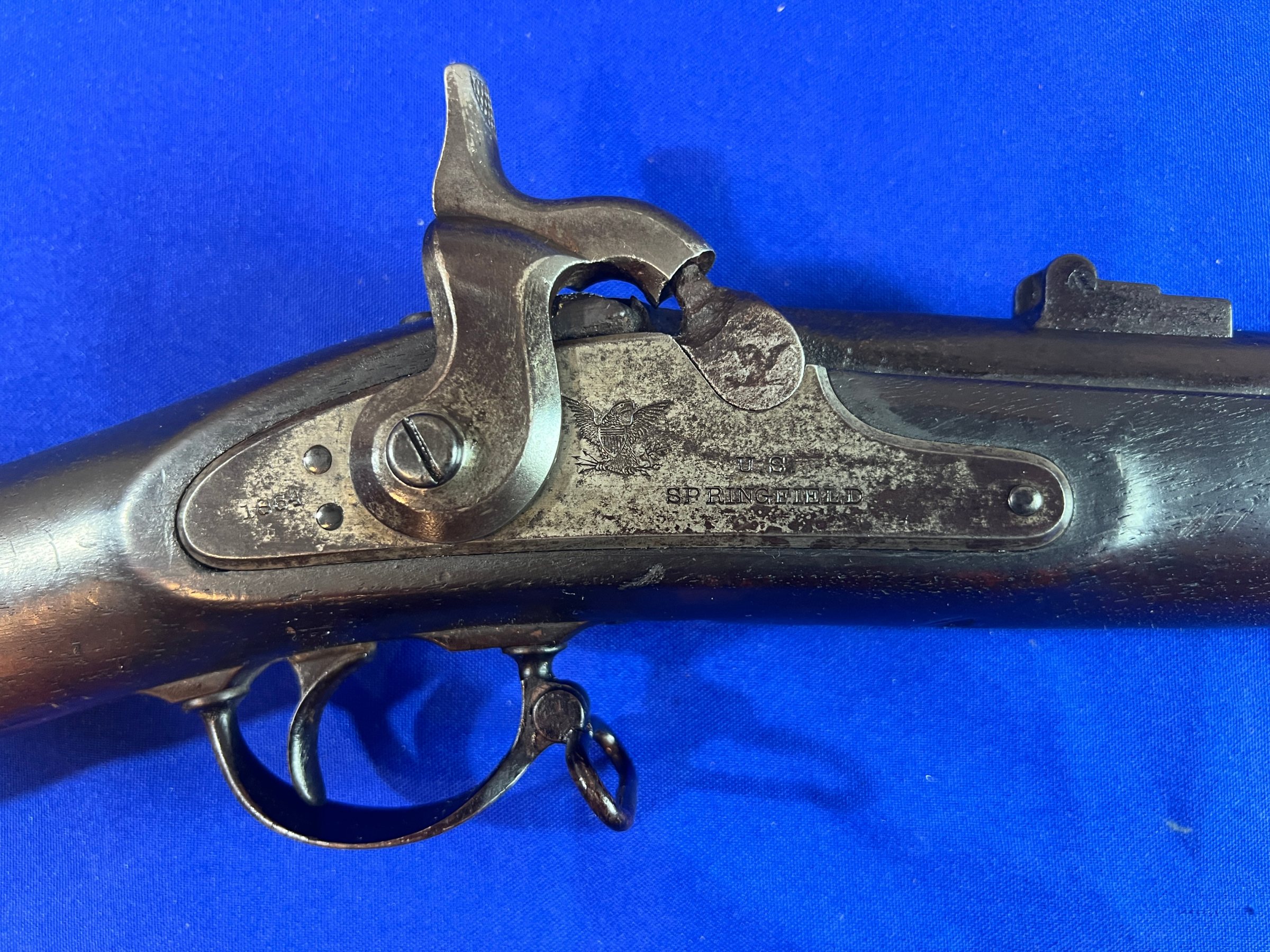
This is a very good example of the Springfield Model 1864 Rifle Musket, still known among collectors as the Model 1863 Type-2, since the changes it incorporates were authorized in November 1863. Even though production did not start until the second quarter of 1864. These rifle muskets saw service in the climactic final battles of the war in 1864 and 1865.
The most noticeable change in this pattern was the reintroduction of band springs, which had been eliminated in the Model 1863 (or “Model 63 Type-1.”) It retained the most noticeable improvement of that model, however: the shorter bolster providing a straight vent to the barrel that provided quicker and more reliable ignition of the charge. This resulted in a thinner lock plate, the use of a flat bolster without clean-out screw and stamped with an eagle, a recurved and beveled hammer, etc.
From March through June 1864 Springfield turned out 58,999 of these rifles; from July through September to another 44,040; and from October through December yet another 54,424; with another 96,877 in the first six months of 1865. Despite these impressive numbers, like most Civil War rifles and muskets, these are not easy to find. The army made it easy for discharged veterans to purchase their arms, many or most of which would be used up around the farm. Between 1867 and 1868 the government disassembled 152,573 Model 1864 rifle muskets so that their parts could be used in the manufacture of new breechloading arms.
All bands, springs, rod, sights, swivels, etc., are in place. The rear sight has the correct single L-shaped-leaf used on the Model 1864. The ramrod is the 1863 (or 1863 Type-1 pattern) with simple swelled tip. The wood has a tight fit to the metal, good edges, and a good surface with warm brown color. The metal has a smooth surface. The markings in the metal are correct throughout. A “US” on the butt plate tang, “1864” lock plate, “V/P/ [eagle head]” barrel inspection stamps at the left breech, “US/SPRINGFIELD” stamp on the lock plate with an eagle and a smaller eagle on the side of the bolster. All the stamps are fully legible. The crisp action works properly at half-cock and full cock.
This is a key piece in any display chronicling the improvements in small arms during the war or one focusing on the decisive battles fought in its final year, and if you had an ancestor serving in the Union infantry at that point in the war, there is a good chance he was carrying one of these. A completely original Civil War firearm and is untouched beautiful.
This is an antique firearm manufactured before 1898. Under the Gun Control Act it is classified by the ATF as an antique, not a “firearm,” and requires no FFL or government paperwork to own. Dixie Relics does not sell modern firearms — every original gun offered is a pre-1898 antique.
It is sold strictly as a collectible antique and should be enjoyed for its historical significance, not fired. By ordering you acknowledge these facts and assume full responsibility.
Antique, curio/relic firearms, firearm parts, and related items may still be subject to federal, state, local, carrier, and payment-processor restrictions. This listing is not legal advice and is not a representation that an item can ship to every buyer or location — please confirm current requirements before purchase or shipment.